
Some panel meters have been in continuous service for over 40 years. Although rugged and reliable, both analog and digital meters are subject to wear and electrical or mechanical damage. Some will eventually need to be replaced. Selecting a replacement meter can be a simple or difficult process, depending on a few key questions.
What Type of Replacement is Available?
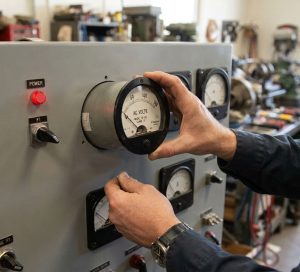 An exact replacement is usually the simplest choice, if it is still available. This option requires little technical knowledge about the application, meter specifications or other meter characteristics. The original manufacturer may still carry the product, or another supplier may have acquired the product line (as Weschler did with the Westinghouse panel meters). Installation is usually straightforward and no operator retraining or procedure updates are needed. However, using an exact replacement may not be an option, particularly for older meters.
A direct replacement is typically a meter that is functionally equivalent and the same size as the original meter. It mounts in the same panel cutout and connects in a similar manner. Often this is manufactured by a different company than the original meter, but to an industry standard. One example is an analog switchboard meter conforming to ANSI C39.1. Some differences in operating characteristics may require technical review to confirm application suitability. For example, substituting a rectifier-type analog ac voltmeter for an iron vane meter.
A recommended replacement is the fallback when an exact or direct replacement is not available. Cost and lead time could also make those options impractical. Users should proceed with caution, however. A recommended meter may differ significantly in form, fit, or function. Confirming suitability typically requires an understanding of the application and a technical review of both specifications and performance differences. Mechanical changes to the panel cutout, mounting, or cabling may also be needed, along with updates to operating and maintenance procedures. For example, the replacement meter may have a different measurement range or front panel controls.
When an old meter fails, users often take the opportunity to consider a meter upgrade. An upgrade offers the same basic measurement function as the original meter, plus additional capabilities. Typical upgrades: adding a digital display to an analog meter, converting to a digital meter, adding digital communication or expanding control outputs. Doing an upgrade involves more risk than doing a replacement. In addition to specification or operating differences, there may be undocumented characteristics of the old meter that are important in the application (e.g. overload recovery time, noise rejection, RFI immunity).
Does the New Meter Make the Same Measurement?
Matching function and range is often the first step in selecting a replacement meter. For dc volts, ac volts, dc amps, ac amps, and line frequency, there are many potential analog and digital replacements. For temperature measurements, analog meters are hard to find, while digital RTD and thermocouple meters can be obtained from multiple manufacturers. Replacement options for an analog power meter are limited, so a digital upgrade may be the best approach. Meters with specialized, modified, or custom inputs are particularly difficult to replace.
In addition to function and range, other input characteristics that should be compared in a replacement assessment include accuracy, resolution, input burden/impedance, response time, and overload rating.
The type of measurement is also important. Is the ac function TRMS or average-responding? A TRMS meter may give different readings than the older, average-responding meter. For RTD and resistance inputs, is the measurement 3 or 4 wire (for lead resistance compensation)? For ac power measurements, is the line configuration supported (e.g. 3-phase, 4-wire, 2½-element)? Is input low isolated from earth and power supply connections (to allow floating measurements)?
Is the Size a Match?
For international products, IEC 61554 lists metric bezel and cutout sizes. These are based on an earlier German standard (DIN 43700) for 1/2 DIN, 1/4 DIN, 1/8 DIN, 1/16 DIN and 1/32 DIN cases. A wide variety of analog and digital meters are available in these sizes. For North American users, ANSI C39.1 specifies analog switchboard and panel instruments. Many digital meters designed for analog replacement also conform to these dimensions. For both standards, the intent is to simplify mixing products from different manufacturers in a panel. However, some size issues can still cause problems when attempting a meter retrofit.
A major size issue: Is there sufficient space behind the panel for the new meter? Depth can vary among manufacturers claiming retrofit compatibility or compliance to a standard. Additional depth may also be needed for mating connectors and wiring.
Another common retrofit problem: connections to the new meter may not match the existing meter.
For meters mounted close together on a panel, the mounting clips, ears, or tabs on the new meter may interfere with adjacent units.
Are There Any Operating Differences?
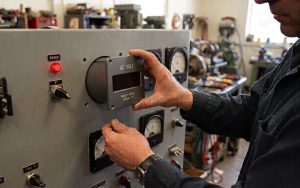 Once installed in the panel, connections made, and perhaps the pointer zero adjusted, the typical analog meter is ready for use. With no front panel controls, the operation of the new meter will be the same as the old meter.
Digital meters often require additional setup, using either the front panel buttons or a computer interface. Front panel button functions are not standardized, so will likely vary on the replacement meter. Front panel setup menus are also unique to each manufacturer. A complete setup may involve selecting display brightness, resolution, offset, filtering, linearization and other parameters.
Operation of control outputs on the new meter will often differ from the original meter. Additional setup steps must be performed to configure each output for the desired operating mode, hysteresis, delay, etc.
A meter with a communication port may require additional front panel setup steps and a new device driver. Changes to the network software are another potential complication when replacing or upgrading a meter with a digital interface.
Frequently Asked Questions
What is ANSI C39.1?
ANSI C39.1 is a standard that defines requirements for electrical analog indicating instruments. It covers direct and alternating current meters, including ammeters, voltmeters, wattmeters, varmeters (reactive-volt-ampere meters), frequency meters, and power-factor meters. Also covered are instruments that make electrical measurements but indicate derived quantities (such as temperature and resistance). Topics include terminology, accuracy classes, performance criteria and test methods. C39.1 was last affirmed in 1981 but is currently inactive. There is no direct replacement standard, so major suppliers continue to follow it for existing equipment and industrial-grade meters.
Can a defective meter be repaired?
There are many ways a meter may fail. Bearings wear in an analog meter, LED displays dim with age in a digital meter. The meter may drift with time and be out of recalibration range. A sudden signal overload may damage the movement in an analog meter or ‘fry’ the input circuit in a digital meter. The meter faceplate may crack or craze. Some repairs are simple; others are extensive and time-consuming. A few meter modification centers do repairs, but each situation is unique. Usually repairing a defective meter is more costly (and will have a shorter life) than purchasing a new meter. Lead time to perform the repair is another consideration.
What is the least expensive way to replace a panel meter?
No single approach yields the lowest cost solution for a failed meter. The total replacement cost has three components:
– Material cost: purchase price of the replacement meter, plus adapters and accessories.
– Labor cost: the time required to evaluate, approve and install a new meter.
– Downtime cost: the lost revenue while the process or service is interrupted.
Meter suppliers can help identify suitable replacements, but only the user’s organization can balance these costs and approve any differences in performance.
Conclusion
Efficient panel meter replacement requires a methodical approach to evaluate the alternatives. Each step from exact replacement to meter upgrade introduces progressively greater differences, which increase the risk and engineering time needed to verify suitability. The more features present in the old meter, the more difficult the task of finding an acceptable replacement.
For more than 80 years, Weschler Instruments has helped users select the right analog or digital panel meter for a wide variety of applications. Our Meter Modification Center carries the Weschler brand plus other major manufacturers. For more information on panel meter selection, see these earlier postings (Panel Meter Overview and Choosing the Right Panel Meter). You may also view our full list of Application Notes.
