
Energy submetering involves installing metering devices (kWh meters) downstream from the main utility meter to track energy usage at a more granular level. Submetering is often employed in multi-tenant residential and commercial buildings with a master utility meter. A submeter for each unit allows the energy cost to be allocated based on a tenant’s total consumption and usage pattern.
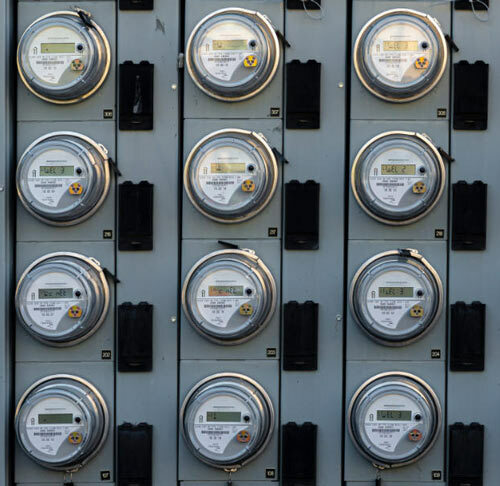 The traditional method for electric submetering was to install an array of electromechanical (spinning disc) meters near the main utility meter. Each submeter was manually read at the same time as the master meter. Energy used since the last reading was calculated and cost for each tenant calculated. In some areas, peak demand was also recorded and bills adjusted accordingly.When digital (smart) meters replaced analog meters, automatic meter reading (AMR) allowed consumption to be recorded more easily and more frequently. In some locations, time-of-use (TOU) tracking permitted the cost allocation to more closely mirror the utility’s rate structure. To assure billing accuracy, most meters advertised as ‘revenue grade’ have an energy accuracy of 0.5%, 0.2% or 0.1% (Class 0.5, 0.2 or 0.1), as defined by ANSI C12.20 and IEC 62053-21. These standards also define other performance requirements and operating conditions.
 Modern digital technology allows an electromechanical submeter to be replaced by a more compact unit that doesn’t require a meter base (socket). Electronic energy meters are typically panel mounted, wall mounted or housed in a DIN-rail case. Examples are the panel mount Crompton 1222 (left), wall mount E-Mon D-Mon E20 (center), and DIN rail Accuenergy AcuRev 1300 (right). RS-485, Ethernet and Wi-Fi are typical communication interfaces for energy submeters. Manufacturer or third-party software can be used for real-time energy management, data collection, analysis and billing.
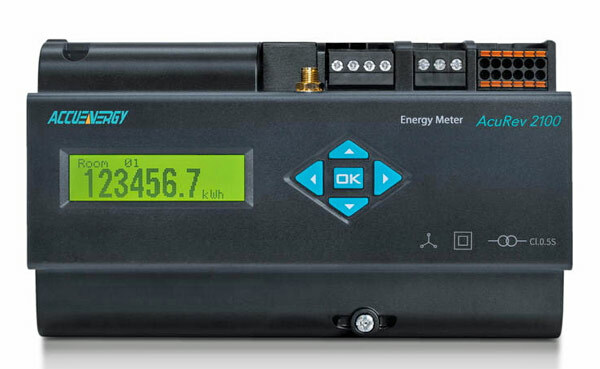 Further improvements in measuring technology now replace a panel of individual energy meters with one compact unit. The AcuRev2100 monitors 18 single-phase or 6 three-phase circuits and is only 162x95x62mm. It is a DIN rail mounted, Class 0.5 meter. Dual Ethernet, WiFi and Serial RS-485 are included with the Web2 option.
Residential submetering has other applications besides tenant billing.In a single-family home, a submeter can be installed to monitor a large appliance (water heater, air conditioner, pool heater, electric over, etc.) as part of a demand response program that limits use during peak hours or shifts operation to off-peak times. Submetering can also provide the data to determine if switching fuels, installing a solar heater, adding photovoltaic panels, or replacing an inefficient appliance is cost justified. In one application, data from a submeter was used to determine payback on the conversion of an electric (resistance) water heater to a heat pump unit.
In an industrial application, submetering can be installed to monitor the energy used by various building systems or production stations. It can help identify abnormal energy consumption patterns. By tracking energy usage in real-time, deviations from normal levels will be quickly detected. Automated controls can then take corrective actions or manual investigations conducted to identify root causes. These actions may prevent equipment malfunctions, energy waste, or unauthorized use and could ultimately lead to reduced operating costs and higher asset utilization.
Digital submeters have many features that enhance their value as system monitors. Most also read voltage and current in real time, so can warn of undervoltage, overcurrent or transient events. Relay outputs allow direct activation of external devices to control or alarm. Analog and pulse outputs can interface with remote indicators, PLCs or DCS systems. Some units also measure power quality parameters such as crest factor, power factor, phase unbalance, and harmonic distortion. These parameters can be input to a facility’s quality management system to ensure compliance with specifications and standards. Meters with data logging store readings periodically for later download and analysis.
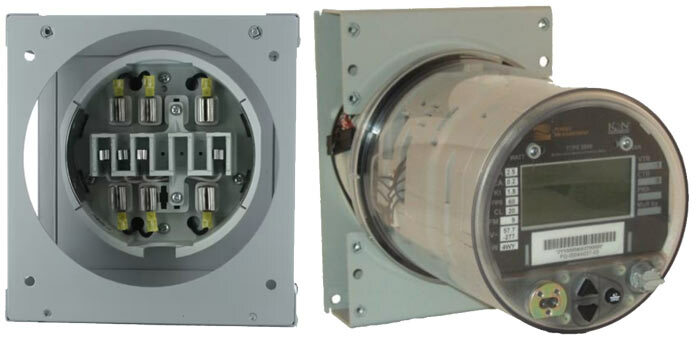
Adapters may be needed for an energy meter installation. SUSI Adapters offers a broad line to facilitate the implementation of a submetering upgrade. Popular products include adapters to mount a socket meter in a panel or a panel meter in a socket.

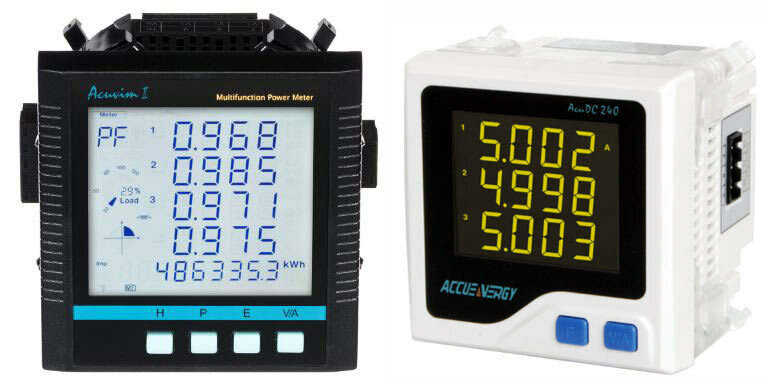 Submetering is also helpful in implementing microgrid solutions. Microgrids are becoming an increasingly important tool for commercial and industrial enterprises. By generating and storing power on-site, organizations have more control over energy use and cost. They become more resilient and self-reliant, and therefore less affected by utility price spikes and outages. These applications typically use a 4-quaddrant (bidirectional) energy meter, such as the Acuvim2 (left). DC metering may be needed to monitor batteries or solar cells. The AcuDC 240 (right) is a solution for these situations.
Residential and commercial submetering provides an incentive for an individual tenant to reduce overall consumption, limit peak demand and/or shift use to a lower-cost time of day. It can also generate the data needed to justify energy saving upgrades. In an industrial environment, submetering provides these benefits at the department or workstation level. It also allows the monitoring of equipment and processes to increase efficiency, improve quality and reduce downtime.
Need Help?
